
School Com adopts new disciplinary rules
State and district to eliminate seclusion
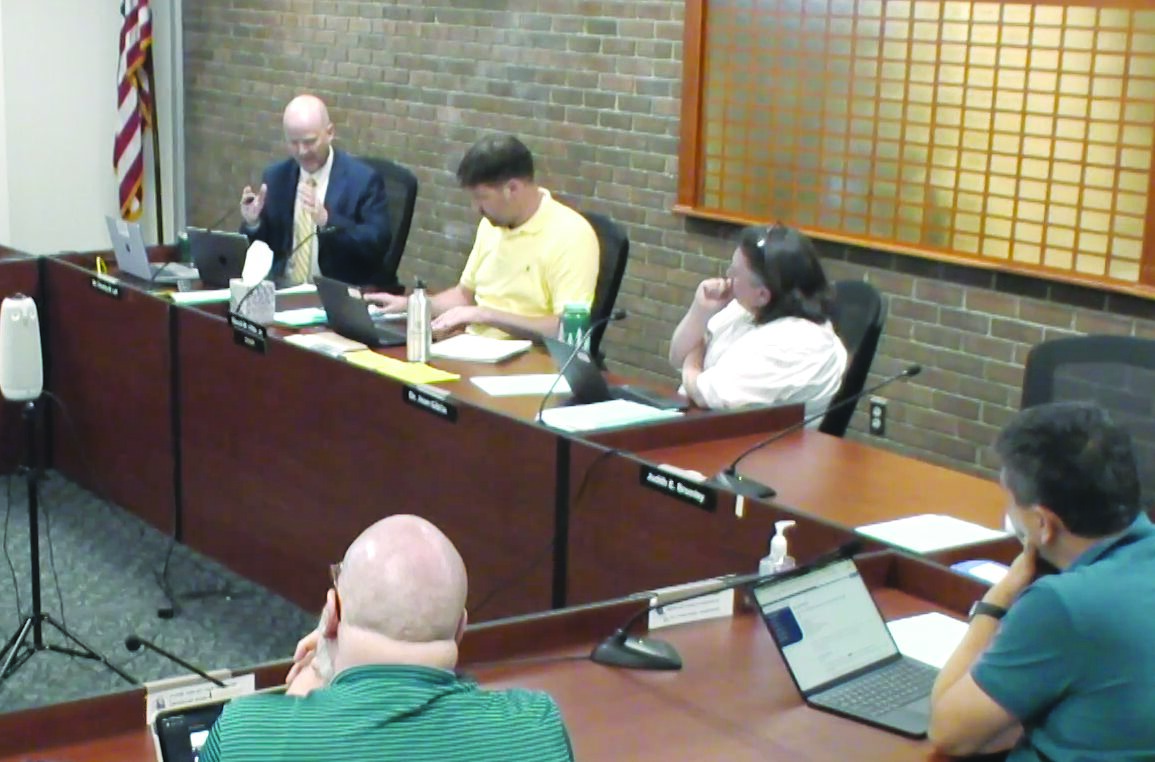
The Norwood School Committee met last Wednesday and voted unanimously to approve new disciplinary rules and regulations updates, ostensibly from the Massachusetts Department of Elementary and Secondary Education.
Former Norwood High School (NHS) Principal and current Norwood Public Schools District (NPS) Director of Safety, Communications, and Compliance Dr. Hugh Galligan reviewed the various changes to the NPS policy, known as Section JKAA. Superintendent Timothy Luff said the new policy is a reaction to other practices across the country.
“This is a response to other parts of the country where kids are just getting locked in rooms, right?” he said. “Which is not something we practice in Norwood anyway.”
The discussion focused on the most intensive disciplinary and safety procedures the schools are allowed to implement, based on specific situations and environments.
Galligan specifically addressed policies around “Physical Restraint”, and then “Time-Out” and “Seclusion”, which he said were two distinct procedures with very different implementations and requirements.
“This addresses changes in the law related specifically to time-out and seclusion,” he said, adding that the changes would go into effect on Aug. 17. “The law is meant to eliminate the use of seclusion and to restrict the use of time-out and redefines both terms.”
The changes specifically look to eliminate the use of seclusion, which according to the handbook – https://gvimes.link/jkaa – is defined as “involuntary confinement of a student alone in a room or area, with or without adult supervision, from which the student is not permitted to leave.”
The policy also specifically defines what is not seclusion, which includes placement in a school environment or classrooms where generally all students need permission to leave, a separate location within the classroom not near other students, or a time-out.
The key difference between a time-out and seclusion, Galligan said, is the ability to leave. He said a time-out is a voluntary action to allow a student to calm down. A student may refuse such a request from a teacher, but he said there would be other disciplinary consequences a teacher might enact. Luff said those consequences also include prescribing care and process for the student.
“In these particular cases you would likely sit with the (Individualized Education Plan) IEP Team or the Safety Team and have a conversation about what different behavioral interventions have to occur to assist this student based on their specific individual needs,” he said.
Galligan added that, while the student has the ability to refuse the time-out and leave the room, teachers are allowed leeway in terms of physical safety to physically restrain a student if they deem it necessary. The policy requires that staff be present to observe the student and “shall cease as soon as the student has calmed.”
“That is the key there, the student can leave,” Galligan said.
Seclusion is still allowed, Galligan said, but the policy states it has to be an emergency situation when a student poses an imminent threat of assault or imminent serious physical harm to themselves or others.
“But only if safeguards are accounted for, and there are many, many safeguards that would be accounted for if we were to use seclusion,” he said.
Galligan said the safeguards are there to ensure that this is a procedure of last resort. Those safeguards are that the student has a documented history of repeatedly causing serious self-inflicted injuries or injuries to others, the student is non-responsive to directives or other behavior intervention, there are no medical contraindications as documented by a licensed physician, there is psychological or behavioral justification for the use of seclusion as documented by a physician, any individual using seclusion has received training and alternative behavior interventions and management techniques, the program has obtained consent from the student’s parent or guardian for use in emergency situations, and the program has documented all this before using seclusion.
School Committee member Joan Giblin asked about the ability of a student to opt out of time-out, to which Luff answered:
“Therein lies the problem,” he said. “This is what’s challenging about the law. Whenever you’re talking about a safety care intervention, if the risk of intervening is less safe than the risk of intervening, then that’s when you have to use physical restraint. So if the kid runs out, and it is dangerous and they are not safe, you might have to use a physical restraint prevention, in lieu of time-out, which is more restrictive, because you’re no longer allowed to use the time-out in the way it is intended.”

Luff said a time-out has always been meant to be a calming period and requires the consent of the student.
“You’ve never been allowed to hold the door or lock the door or anything like that – that’s already in play,” he said. “This just makes it more clear. But always, if a student is going to leave that space and go, [for example] run out into the road and might get hit by a car, you are going to have to physically intervene.”
“You can direct a student to a time-out, but they have to be able to leave,” Galligan added.
Giblin confirmed this is dependent on the environment. Like if it’s a situation at Cleveland, a student would exit out into Nichols Street.
“Which is a super busy street and you’re going to have to grab that kid, whereas if you’re at the Willett, you’re in the middle of the woods,” she said.
“In that particular scenario, that is true, because every time you even consider doing that restraint, you have to think about less intrusive interventions, and obviously it’s less intrusive to let a student sit in the woods, right, whereas if a student is going into the road, there is no less intrusive,” Luff said. “So it’s going to be a very individualized situation.”
Galligan stressed that public safety here is paramount and that other laws protect NPS’ ability to keep all in its jurisdiction safe.
“Our legal team does have, in the policy, ‘Nothing in this policy shall preclude a teacher, employee or agent of NPS from using reasonable force to protect students, other persons, or themselves from assault or imminent serious physical harm,’” Galligan said. “That is its own law.”
About the author
Jeff Sullivan Covers local news and community stories.
More in this section
Selectmen on bagel sculpture, the Fourth, concerts, power and public safety
Norwood Fire vehicles delayed, cops say ‘lock your cars’
June 11, 2026
Comments